Case study 03 · 2026
Autonomous Traffic-Aware Robot Car
A Raspberry Pi robot car that follows lanes, reads traffic signs, and takes voice commands to drive a track autonomously.
See the project in action.
Context
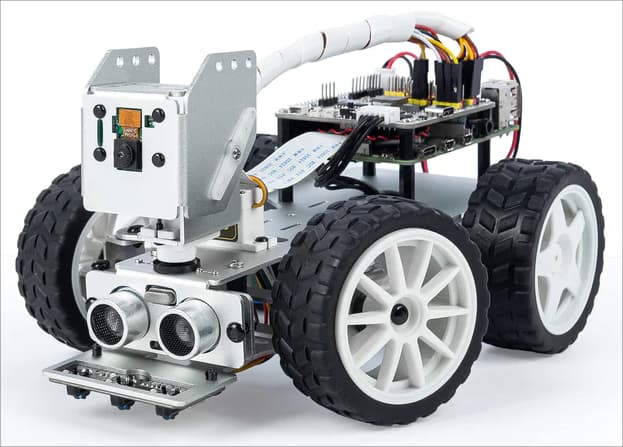
The SRH Heidelberg BIP challenge gave us a few days and a SunFounder PiCar-X with one goal: make it drive a track completely on its own. It needed to follow a lane, read a traffic sign, turn correctly, complete the loop, and stop at a STOP sign - with bonus points for voice commands and obstacle handling. I owned the voice-control system and the turn-execution logic.
The system
We designed a split brain. The Pi handles everything real-time - lane following, steering, speed, voice, and its ultrasonic sensor - while a YOLO traffic-sign model runs on a GPU laptop. The car streams frames over Wi-Fi and receives detections as JSON. Driving never depends on the network: if Wi-Fi drops, the car keeps following the lane because detection is advice, not a requirement.
What I built
My offline Vosk voice system listens on a separate thread from the drive loop and keeps a fast local parser available whenever the language model is slow or unavailable. Safety shaped the implementation more than the happy path.
- “Stop” fires instantly from the partial local transcript and never waits for a network request.
- A two-second timeout and generation counter discard stale language-model replies.
- Negated or ambiguous commands are ignored, while an RMS gate and fuzzy matching improve reliability.
- Detected signs arm a maneuver; the car waits for all three floor sensors to confirm the intersection before turning.
Outcome & reflection
By the demo, autonomous lane following, sign response, voice control, and obstacle stopping all worked. Steering around an obstacle was the honest gap we scoped out in favor of a reliable stop.
This was my first time writing code that drives physical hardware in real time. On a screen, a bug is a wrong answer; on a robot, it can mean driving off a table. Designing safe behavior first - instant local stop, stale-command rejection, and explicit intersection confirmation - changed how I think about what “done” means.